
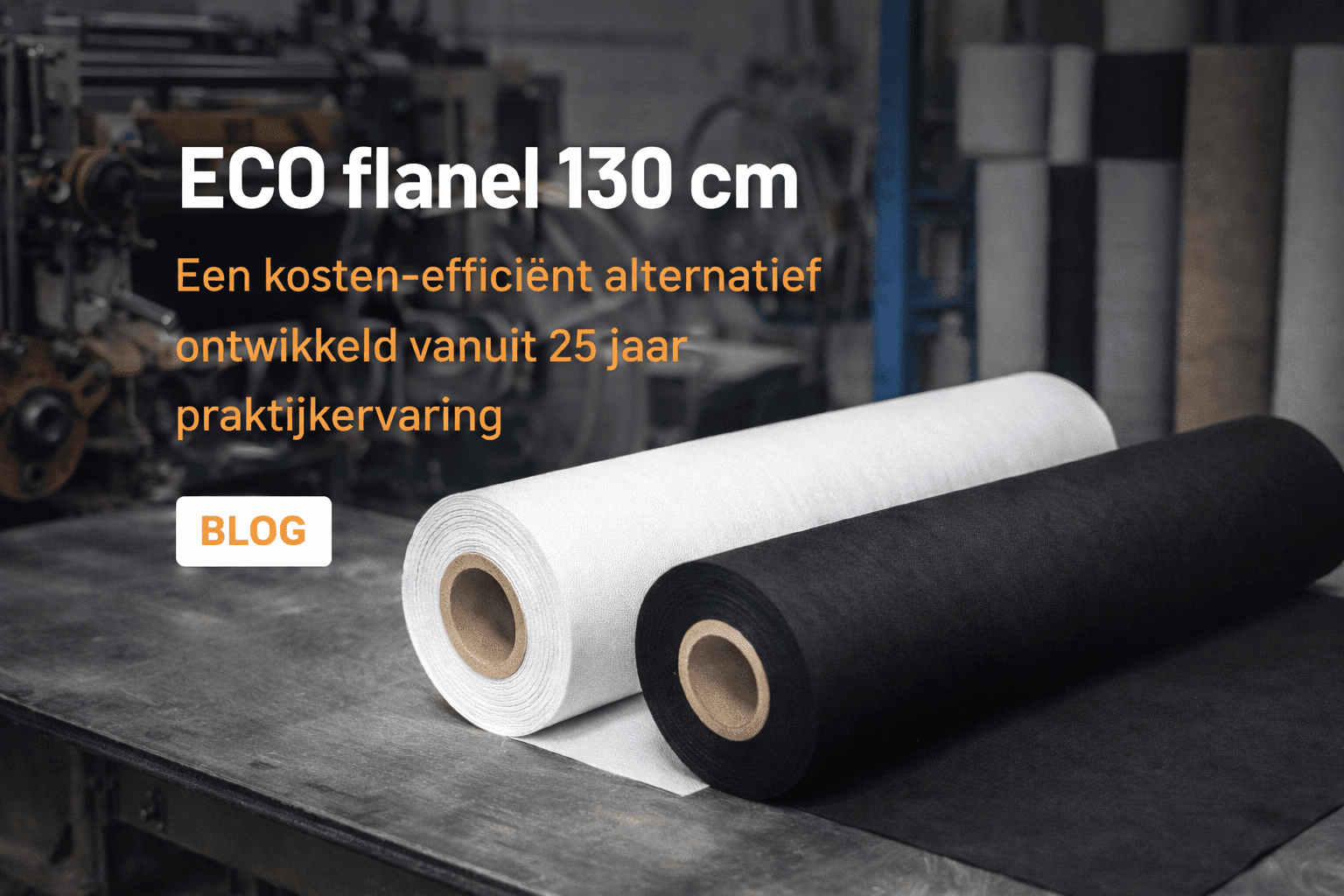
Deco Molton ECO developed on the basis of 25 years’ practical experience
After more than 25 years working in the events and textiles sectors, you start to see patterns emerge. Not only in applications, but also in products that have been used unchanged for years, even though practical experience has long since shown that there are smarter ways of doing things.
Deco Molton is a good example of this. It is a tried-and-tested, reliable material for events, theatre and set construction. But over the years, we also noticed something else. In many applications, Deco Molton is made with a heavier gauge than necessary.
That insight formed the starting point for the development of Deco Molton ECO.
From practice to product choice
In the day-to-day practice of stage finishing, stand construction and decoration, Deco Molton is almost always used in the same way. The visible side determines the appearance. The reverse side rarely plays a role.
Nevertheless, Deco Molton is traditionally sanded on both sides as standard. This creates a rich appearance, but also involves an extra processing step in the production process.
Based on years of experience across a wide range of productions, a different approach has therefore been deliberately chosen.
Deco Molton ECO is sanded on one side only – exactly where it is needed.
By omitting one roughing operation:
-
less machine time is required
-
less energy is consumed
-
production costs are reduced
Without this affecting the appearance or functionality in most applications.
Reducing weight without compromising function
In addition to the finish, close attention has also been paid to the specific gravity.
Standard Deco Molton weighs an average of 165 grams per m².
Deco Molton ECO has been developed to weigh approximately 140 grams per m².
That difference may seem small, but it has clear implications for production:
-
less cotton per square metre
-
less dye required to achieve the same colour
-
less impregnating agent for the fire-retardant treatment
The result is a Deco Molton that can be produced more efficiently and is therefore competitively priced, whilst the visible side retains the same rich, matt finish.
Economic and logistical benefits
The lower weight brings benefits not only in production but, in some cases, also in logistics.
For larger volumes, a lower weight means:
-
lower postage costs
-
more efficient transport
-
easier handling on site
These differences per roll may not be spectacular, but in professional projects, details like these certainly do make a difference.
Applications where Deco Molton ECO is equivalent
Based on years of use in a wide range of production environments, Deco Molton ECO is, in most cases, functionally equivalent to standard Deco Molton, including in:
-
stage finishes
-
backdrops
-
set construction
-
temporary event structures
-
exhibition stand construction, where Deco Molton is used as a finish or cladding
The visible side meets the same standards that professionals have come to expect from traditional Deco Molton.
When Deco Molton Premium remains the better choice
There are also situations in which Deco Molton Premium is the preferred option. In particular when:
-
walls are upholstered individually
-
the underlying walls vary significantly in colour
-
a completely uniform black surface is required
In these specific applications, the slightly lower weight of Deco Molton ECO may not be quite sufficient to completely even out colour differences. In such cases, heavier, standard flannel remains the safer choice.
This distinction is important. Not every product is intended as a universal solution.
Conclusion
Deco Molton ECO did not arise from a marketing idea, but from practical experience.
By taking a critical look at what is actually required in most applications, unnecessary processing steps and material usage could be reduced.
The result is a Deco Molton that:
-
performs consistently across virtually all applications
-
is produced more efficiently
-
is lighter
-
and can therefore be offered at a significantly lower price
Not because it is inferior.
But because it has been designed by people who have been working with this material for decades.